Showing posts with label amulet. Show all posts

Wednesday, January 16, 2013

Coin magic

Coins are among the oldest manufactured artifacts of human civilization, and they have possessed magical properties from the earliest times. Ancient coins were often stamped with images of deities to invoke the power of their protection, or with magical mottoes or charms that would empower or protect anyone who possessed or handled the coin. As late as the mid-20th century, before the introduction of decimal currency in Britain, the florin coin was still marked with a cross, and many people made sure to always keep a florin in their coin purse “to keep the Devil out.”

“Lucky pennies” are still common charms and souvenirs (a friend brought me this one in a tiny ‘witch bottle’ from a visit to Salem many years ago) kept for luck, prosperity and gambling success. Some coin amulets are special “lucky coin” medallions, but usually an ordinary coin is used, either worn as a pendant or bracelet, or put in a “mojo bag” with other magical ingredients. Besides being used for luck, coins can also be used for personal magical protection against malign witchcraft or the Evil Eye. Silver coins are especially used for this purpose; when a silver coin charm turns black, it is supposed to have successfully turned away something sent to harm you.

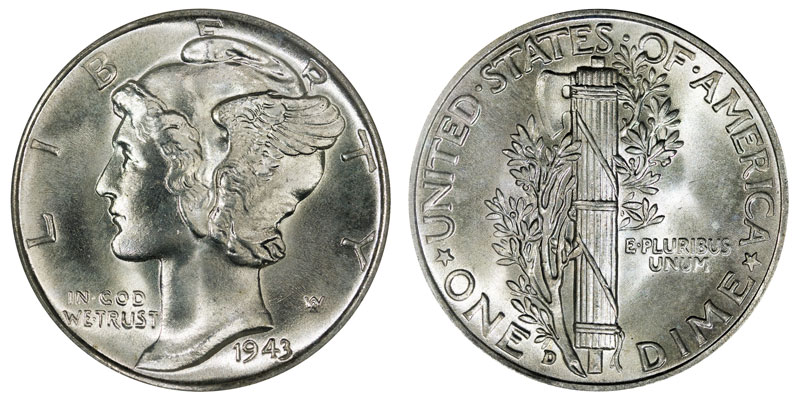
Although any coin can be used as an amulet or charm, the variety of images stamped on them means that some are believed to possess more magical power than others, and some are especially suited for particular uses. In the US, two coins traditionally used for gambling luck and protection were the Indian Head penny and the Silver Mercury dime. The dime (shown above) was doubly effective because it was solid silver - a protective metal - and because it showed a figure of Mercury, the Roman god of the crossroads, gambling and communication. (Actually the coin was meant to depict “winged Liberty”, but nobody has ever seen it as that.) Additionally, coins with significant dates - leap years, your own birth year, etc - are especially potent.

These two coins, of course, haven’t been minted for almost a century (though they’re easily available from coin dealers for only a few dollars each) but there are lots of modern coins whose images make them very suitable for magic use. The US has two one-dollar coins still in circulation, both depicting strong women whose image would be useful to invoke in magic charms or spells: Susan B. Anthony for political action, protection of civil rights or perhaps sobriety (she was a leader of the temperance movement) and Sacagawea for travel, finding your way, or even clarity of understanding (although she's known as Lewis and Clark's guide, she mostly acted as a translator). As well, the dollar shows Sacagawea holding her newborn son, giving it a correspondence to motherhood, family and childbirth. In Canada, the mint has just issued two quarters commemorating the War of 1812 that will be very good for protective magic; one shows General Isaac Brock and the other the Shawnee chief Tecumseh, who together defended Canada from the invading US forces. The red enameled maple leaf on some of the quarters could make them even stronger magically, as red is a colour traditionally used for magic charms.

So what can you do with these coins, magically speaking? Well, the simplest and most traditional thing is simply to keep them on your person, either made into a piece of jewelry or just kept in a pocket or purse. A coin can become a protective amulet simply by your recognizing it as such, but most people will want to do some ritual to “magic it.” This can be as simple or elaborate as you prefer, but will usually include cleansing to remove any existing energies from the coin, consecrating or blessing it, such as with holy water, incense, condition oil or moonlight, and charging it with your intent. The longer you wear the coin or keep it on your person the more it will become part of your magical personality and respond to your needs.


But coins are also often incorporated into mojo bags, talismans or other magical artifacts. In traditional American witchcraft, silver Mercury dimes were often included in witch bottles, mojo hands or other protective creations, along with herbs, roots, stones, spell papers, animal parts or other ingredients. If the charm being made is very small, sometimes only a sliver or a few filings from the coin are included, but it is still enough. Usually the coin is just sewn into a packet with the other materials, but for protective amulets I like to keep the coin visible, as on this little house protection charm I made. Because coins are shiny and round, they have long been used to deflect the Evil Eye and other malign influences, so by featuring the coin on the outside, you get extra magical value from it. Coins can be drilled and sewn on like sequins, but one excellent way to attach a coin to a fabric pouch is to sew it on like a shisha mirror. Here is a simple tutorial on this, from Joyful Abode. I’ve used a tiny Swiss coin with an image of an armed woman carrying a shield, and filled the packet with three protective herbs: basil, rosemary and elderberries.  This would be a good charm to hang over your door, with the coin facing out to anyone approaching your home. 

Sunday, January 22, 2012

Bone

Bone was probably one of the first materials used by humans to create sacred objects. It's readily available, fairly easily worked, and even the most primitive societies readily recognize that bones are directly related to the person or animal from which they came. As blood has always represented Life because it comes only from living creatures, bones have always had a connection to Death because they are all that remains of us when we die. Although most of us no longer have mounds of fresh bones cluttering up the kitchen every day, modern Pagans can still use bone in many forms to connect with our Gods and especially our Ancestors.

The simplest and perhaps most beautiful way to use bone in a sacred setting is to place an animal bone or skull on your altar. At Samhain, skulls (either real or sculpted) are de rigeur, but they can be kept on an Ancestor altar year-round. Skulls and bones of animals and birds can be bought in stores or online, or even found in the wild. I have a couple of small skulls (a squirrel and - I think - a skunk) that I just found in our urban back yard. The intricacy and simplicity of skulls makes them quite beautiful, and they can be left bleached white, stained or painted. If you have a totem animal that you connect with strongly, a skull or bone of that specific animal can be a powerful bond, but ultimately all bones connect to our own ancestry at its most ancient.

Bone can also be used as a creative material in many ways. One of the oldest forms of bone craft is scrimshaw, which is simply scratching designs onto bone and staining the markings to make them visible. This is a wonderful way to make amulets and talismans, and the availability of small bone disks and plaques from craft and bead suppliers means you don't have to prepare your own from raw bones. (Which is cheap and fairly easy, but messy and not for the squeamish.) Bone is fairly hard, so you need to use a fairly sharp tool to engrave it. A short-bladed knife or a sharp awl will work, though care is needed to do a neat job and prevent accidents. A Dremel or other motor-tool is excellent for this, though grinding bone with a tiny drill does produce a characteristic smell that may invoke unpleasant memories of dentistry. When you have marked your rune, petition, sigil or other design, paint into the lines with ink or thin paint (India ink is traditional for this, and works very well) and wipe it off the surface to leave only the fine markings darkened.

While at the bead store, you can usually find other kinds of bone beads that are perfect to use in magical crafts. Cylindrical, oval and round bone beads are readily available, as are long tube beads which can be either sewn on or left hanging as pendant decorations. I particularly like these because of the lovely rattling sound they make. (Incidentally, this is the first test of whether beads are real bone or plastic - bone always knocks together with a high-pitched "click", while most plastic sounds dull.) Many suppliers have small Tibetan skull beads carved from bone, which seem inherently magical.

A simple bone craft that you can create, as part of a ritual or just by itself, is a bone cross. I made the one shown here in a workshop with the Niagara Voodoo Shrine a few years ago, and it's a protective charm that can be hung over the door (as I do) or anywhere else in your home to invoke the powers of the dead to protect your home and family. Besides the Ancestral connection of the bones themselves, the shape is a representation of a crossroads, which is a traditional place to petition the dead for help. Any large fowl bones and good for this, turkey, goose or even very large chickens, which can be kept from your next big family dinner (which connects the cross even more closely to your family) or you can buy two large turkey legs, make soup with the meat and use the bones. Clean the bones very thoroughly and put them into a pan with water and a little chlorine bleach to soak for a while. This will sterilize and bleach the bone. Hang them to dry, preferably in the sun, for several days.

To make the cross, simply attach the bones together with a dab of hot glue to hold them while you lash them together with yarn or embroidery thread. White, black or red are all traditional colours for this, or you can use any colours that seem right to you. Tie a small loop onto the top of the upright bone to use as a hanger, and decorate the cross with buttons, beads, cord or anything else that speaks to you. I used old buttons, a plastic skull, glass beads and red leather thongs. As you create the cross, concentrate on your intent to create a powerful protective amulet, and request the assistance of the dead, your own ancestors and those spirits who remain among us, to keep your home safe. The more time you take to add decoration to it, the longer you have to imbue it with your intent as you work.

Hang the cross over the main door or in a central position in your home. You can put it in an out-of-the-way place if you're worried people might think it's creepy, but mine has been hanging in plain sight over our front door for several years and nobody has even noticed it. (Many of us already have enough odd things in our homes that one more won't make much difference!)