Monday, January 28, 2013

Esbats: the power of the Moon


"Cold Moon" by Mandykaye


ESBAT:
A gathering or ritual by pagans, witches, and/or wiccans to celebrate the moon.


 I have always found the moon magickal and enchanting! As a child, I would wish upon the stars and dance under the moon until my mother would call me in. There are many ways to celebrate the moon in its many phases. I am a solitary pagan/witch, so I usually do a modest and quiet ceremony when I am able.
  You can use the moon for divination, cleansing, dream magick and goddess magick. These are just a few examples. I usually stick with the colors white and silver. The stones/crystals associated with the moon are quartz, moonstone, pearl, sapphire and selenite. The different phases of the moon dictate what spell work is favorable. Monday is ruled by the moon as well.
  The waxing moon is the best time to perform magick regarding fertility, love, protection, and prosperity. (This is the time from the new moon to the full moon). The waning moon (full moon to new moon) is best for banishing spells such as breaking bad habits, releasing negative energy, or breaking curses or hexes. The new moon (invisible moon) is a good time for cleansing and reflection. And the full moon is for any moon magick! There are rituals in which you can invoke the power of the goddess that is represented by the moon.
  While most Esbats are celebrated on the full moon, the type of magick you want to perform may best be done on a different night. I personally use the power of the full moon for cleansing my crystals. Others use the power of the full moon to make a type of "holy water". 
  Here is a link to charts with the phases of the moon  by NASA. http://eclipse.gsfc.nasa.gov/phase/phase2001pst.html
 
  Whatever your path may be, there is no doubt the beauty of the moon is powerful! However you celebrate this power, be sure it is from your heart and soul. Magick is personal so if you find a spell you like, change it to suit you. As long as your intent is pure, it will be so. You can find many good spells and rituals from books such as Wicca:A Guide For The Solitary Practitioner by Scott Cunningham. For groups, Wicca For Life  by Raymond Buckland, is a good choice for detailed rituals. There are also some rituals for Esbats in Green Witchcraft by Ann Moura. For more of a cottage witch approach, Ellen Dugan has some good books.


Goddess Moon by mave
Field of pure moonlight
Blessed by silver light
Trees and plants of green
glow with spirits might
Nature’s creatures raise their
voices in song
To their mistress high in the sky
Goddess Moon riding through the night
Bless us with your cleansing light
Let not fail our spirits
Guide us through rough times
Teach us your lessons
Goddess moon give us strength
Goddess moon give us wisdom


Blessed Be!


Monday, January 21, 2013

Déesse

Déesse means Goddess, in French. It's the name I use when I think of what's holy and whole in this world.

The Goddess is in everything. She's everything.
 She is the light in the sky, and the blackness surrunding them as well.

She breathes with the trees, and walk every steps we take.
With us.
Within us.

She is the connexion with everything that is.
Every spiders I avoid to crash with my feet.
Every golden leaf I humbly appreciate.
Every nut that could have become a tree, 
but instead feeds me, and my growing belly.

The lightest laugh and the most painful tear.
That urge to live, 
Every second.

That spinning, overwelming sensation
When you close your eyes
And feel.

Feel that everything you do has an impact on another living
That every choice you make
Leads you to your next choice.

That certainty that you'll end up right where you were meant to.
And realize
That the path is not yet at its end.

The Goddess is in every crossroads.

Wednesday, January 16, 2013

Coin magic

Coins are among the oldest manufactured artifacts of human civilization, and they have possessed magical properties from the earliest times. Ancient coins were often stamped with images of deities to invoke the power of their protection, or with magical mottoes or charms that would empower or protect anyone who possessed or handled the coin. As late as the mid-20th century, before the introduction of decimal currency in Britain, the florin coin was still marked with a cross, and many people made sure to always keep a florin in their coin purse “to keep the Devil out.”

“Lucky pennies” are still common charms and souvenirs (a friend brought me this one in a tiny ‘witch bottle’ from a visit to Salem many years ago) kept for luck, prosperity and gambling success. Some coin amulets are special “lucky coin” medallions, but usually an ordinary coin is used, either worn as a pendant or bracelet, or put in a “mojo bag” with other magical ingredients. Besides being used for luck, coins can also be used for personal magical protection against malign witchcraft or the Evil Eye. Silver coins are especially used for this purpose; when a silver coin charm turns black, it is supposed to have successfully turned away something sent to harm you.

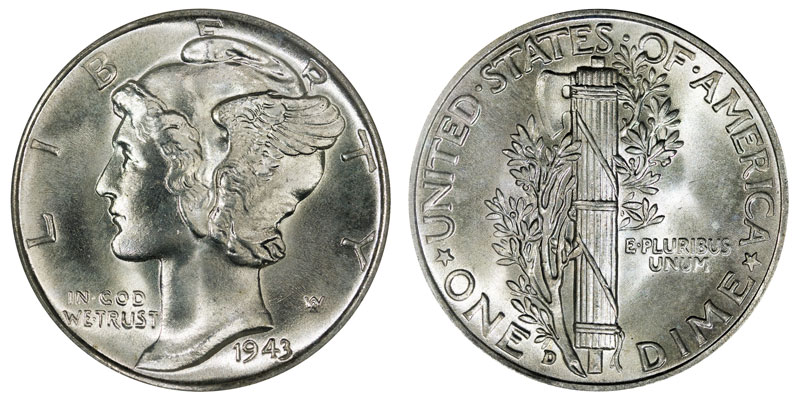
Although any coin can be used as an amulet or charm, the variety of images stamped on them means that some are believed to possess more magical power than others, and some are especially suited for particular uses. In the US, two coins traditionally used for gambling luck and protection were the Indian Head penny and the Silver Mercury dime. The dime (shown above) was doubly effective because it was solid silver - a protective metal - and because it showed a figure of Mercury, the Roman god of the crossroads, gambling and communication. (Actually the coin was meant to depict “winged Liberty”, but nobody has ever seen it as that.) Additionally, coins with significant dates - leap years, your own birth year, etc - are especially potent.

These two coins, of course, haven’t been minted for almost a century (though they’re easily available from coin dealers for only a few dollars each) but there are lots of modern coins whose images make them very suitable for magic use. The US has two one-dollar coins still in circulation, both depicting strong women whose image would be useful to invoke in magic charms or spells: Susan B. Anthony for political action, protection of civil rights or perhaps sobriety (she was a leader of the temperance movement) and Sacagawea for travel, finding your way, or even clarity of understanding (although she's known as Lewis and Clark's guide, she mostly acted as a translator). As well, the dollar shows Sacagawea holding her newborn son, giving it a correspondence to motherhood, family and childbirth. In Canada, the mint has just issued two quarters commemorating the War of 1812 that will be very good for protective magic; one shows General Isaac Brock and the other the Shawnee chief Tecumseh, who together defended Canada from the invading US forces. The red enameled maple leaf on some of the quarters could make them even stronger magically, as red is a colour traditionally used for magic charms.

So what can you do with these coins, magically speaking? Well, the simplest and most traditional thing is simply to keep them on your person, either made into a piece of jewelry or just kept in a pocket or purse. A coin can become a protective amulet simply by your recognizing it as such, but most people will want to do some ritual to “magic it.” This can be as simple or elaborate as you prefer, but will usually include cleansing to remove any existing energies from the coin, consecrating or blessing it, such as with holy water, incense, condition oil or moonlight, and charging it with your intent. The longer you wear the coin or keep it on your person the more it will become part of your magical personality and respond to your needs.


But coins are also often incorporated into mojo bags, talismans or other magical artifacts. In traditional American witchcraft, silver Mercury dimes were often included in witch bottles, mojo hands or other protective creations, along with herbs, roots, stones, spell papers, animal parts or other ingredients. If the charm being made is very small, sometimes only a sliver or a few filings from the coin are included, but it is still enough. Usually the coin is just sewn into a packet with the other materials, but for protective amulets I like to keep the coin visible, as on this little house protection charm I made. Because coins are shiny and round, they have long been used to deflect the Evil Eye and other malign influences, so by featuring the coin on the outside, you get extra magical value from it. Coins can be drilled and sewn on like sequins, but one excellent way to attach a coin to a fabric pouch is to sew it on like a shisha mirror. Here is a simple tutorial on this, from Joyful Abode. I’ve used a tiny Swiss coin with an image of an armed woman carrying a shield, and filled the packet with three protective herbs: basil, rosemary and elderberries.  This would be a good charm to hang over your door, with the coin facing out to anyone approaching your home. 

Tuesday, January 8, 2013

B is for Books


I have always found books to be magical. Well before I began my path as a pagan I was an avid reader, and found the escape and wonder that books can provide. Through books I could travel to magical lands, find answers to questions, and learn what kind of person I wanted to be.

So, when I was 16 and I began looking into wicca/witchcraft the first place I turned was books. I bought my very first books from the walden books in my local mall. The books were the witches almanac and True Magick by Amber K. The almanac went over my head in many ways. The correspondences meant nothing to me. True Magick, was a more interesting story. I read the book clear through multiple times, and truly related to many things about the religion she described, but she talked also about having to have specific tools, and only wearing natural fabrics, and not eating meat, and suddenly I wasn't at all sure about this new religion. Let me say clearly that True Magick is not a bad book, but it was not the book I needed as a seeker.
I never gave up on this new religion, but I became a dabbler for several years until I signed up for a class called Wicca 101 at a local metaphysical bookshop in my hometown. I remember that first day, feeling like an impostor, and being so nervous that everyone would be able to tell how green I was. But instead I found a group of great people, and a teacher named Heather, who explained everything, and made the religion more real, and the things more unnecessary. Over the course of the class, which was once a week for a month, she walked us through making holy water, finding a magical name, basic spell work, and it all culminated with a beltane ritual that included a may pole dance. It was amazing. I knew I had found my place.

Heather had book suggestions, and for a brand new witch she advised To Ride a Silver Broomstick by Silver RavenWolf. This book, and it's two accompanying books, To Stir A Magick Cauldron and To Light a Sacred Flame, would become my lifeline for years. They would also lead me to find Scott Cunningham's Wicca: A Guide for the Solitary Practitioner, and many other famous authors.

Having been a practicing witch now for 13 years (wow, that's a shocking number to me) I now have a list of favorite books and authors for different subjects and studies. Here is a list of some of my favorites. If you have something to add or have any thoughts, please comment on the post and let me know. Otherwise here is the list.

Animal Magic and Totems: Animal Speak by Ted Andrews
Herbs: Cunningham's Encyclopedia of Magical Herbs by Scott Cunningham
           Garden Witch's Herbal by Ellen Dugan
Stones: Cunningham's Encyclopedia of Crystal, Gem and Metal Magic by Scott Cunningham
Books for Beginners: see above, plus
            Witch by Fiona Horne
            The Witch's Guide to Life by Kala Trobe
Spells: Everyday Magic: Spells and Rituals for Modern Living by Dorothy Morrison
Sabbats: Season's of Witchery by Ellen Dugan
              Lewellyn Holiday Series by various authors

I could keep going on and on and on, but I am going to cut myself off here. I will also add that I love pretty much anything written by Ellen Dugan and Scott Cunningham, but there are also many other amazing authors out there. I find the best thing to do is go to your library or local bookstore and get reading to find the authors who speak to you the most.

Blessings
AlphaBetsy

Tuesday, January 1, 2013

One Pagan's Altar

Brightest Blessings to you all as we begin the New Year! I am hoping to start off this year diving back into the things I love most, and I am beginning with my faith. As this last year was coming to a close, I was feeling very down and drained, like something was missing. I realized that the last time I has seriously sat down and worked out a spell, grounded myself, or even lit a candle for some quiet meditation was right before my youngest daughter was born back in the summer! I just happened to look up a few nights ago as I was letting the dog out and noticed that the moon was reaching full and got right to work. I found some jars for making my version of holy water, some uncharged candles, and a few other items I wanted to charge in the light of the full moon. I dug out some of my favorite go to books for Pagancrafting and found some recipes I had bookmarked for later use. As I sat outside in the chilly light of the magnificent full moon I felt renewed. A huge weight seemed to be lifted off of me and I said a silent thank you to Mother Moon for reminding me of what is important. So here I am now, kicking off what I am hoping is the beginning of a complete Pagan Wheel of the Year and Alphabet.


The Altar


A pagan altar can sometimes bring images of disturbing sacrifices, smoky candles, and an odd array of cliché paraphernalia. A simple definition is an altar is a work space and a sacred place to both worship and create things we hold dear. 


 This is an example of the diagram I used when I first started practicing, a very good start for any beginner. I still use a lot of these basic elements when I have my traditional altar set up.


My personal altar is mainly used for the later, a place for me to pay tribute and worship at. It is also a calming place where I sometimes write spells or work on my book of shadows. I love to change the altar's appearance for the season or the upcoming Sabbat. Making it a place of beauty that I think anyone would want to be around. Over the years my altar has moved and changed, much like myself. It started out as a low to the ground, large table where I placed everything I had on or near that I felt “showed” that I was a witch. As I grew older (and wiser I feel) my altar has gotten smaller and more intimate. I place things that I feel strongly about and use often on it. Since I am not completely “out of the broom closet” so to speak, most visitors didn't even know what it was! This past year I got a surprise blessing of a 4th daughter, while my then youngest was still small. I had to put my precious altar away almost completely so things couldn't get misplaced, or damaged by tiny hands learning to crawl, walk, and grab everything. I felt saddened by this and once again my altar has morphed into something that better fits my needs at this point in my journey through life. 


Blessings!
Ani

Friday, March 9, 2012

Eggs - Ukrainian pysanky


Though most people who make them are Catholics and their designs are described as Christian symbols, pysanky, the intricately decorated Easter eggs for which my Ukrainian ancestors are famous, are so blatantly Pagan in their rituals and motifs that they can be incorporated into our Ostara celebrations virtually unchanged. I thought this would be a good time to share some of those traditions and offer some suggestions how they can be incorporated into our celebration of Ostara. The eggs take a while to decorate, so you'll want to start now to have them ready for your Ostara altar.
 
Traditionally, Ukrainians make two kinds of Easter eggs: krashanky, hard-boiled eggs dyed a simple colour, usually red; and pysanky, raw eggs decorated with patterns of white, black and colours through a batik-like process. Both are prepared for giving as gifts and for ritual purposes, but the krashanky are eaten while the pysanky are kept and eventually dry out to hollow shells. A young woman would give a pysanka or krashanka to a boy she was interested in, children would be given krashanky as blessings and to play games with on Easter Monday. Beautifully decorated pysanky would be made for honoured friends and family members, and one would always be given to the priest. As well, both kinds of eggs were used for purely ritual purposes. Eggs blessed by the priest on Easter were kept in the home to protect it from fire, or in the barn to protect the livestock. Pysanky were thought to be so magically potent that if a blaze did break out, eggs would be thrown into the fire to extinguish it. The touch of a krashanka was believed to cure blood poisoning, and a person who was gravely ill might wear a pysanka around his neck as a healing talisman. Farmers would roll a krashanka in green oats and bury it in the fields to ensure the fertility of the crops, place one under their hives to protect the bees or bury four pysanky at the corners of the foundation when a house was being built. Pysanky were put into the coffins of loved ones to protect them on their way to heaven, or a krashanka might be placed on the grave of a dead child.

The making of pysanky was itself a ritual act, traditionally done only by women, at night after the men and children were asleep. (Though today more men take part, and some of the most beautiful pysanky I’ve seen are made by my uncle, at night after his wife goes to bed.) A beeswax candle is first lit on the work table, and a brief prayer is always spoken before beginning. Traditionally only fertilized eggs were used, and the eggs meant for the most magical purposes were taken from young hens that had only just begun to lay. Small groups of women might meet to decorate pysanky together, but more often it was done privately by one or two women in the household. The finished eggs were always kept hidden until Easter. This was women’s magic and had to be kept from the sight of men to remain potent.


Modern kystkas give very fine control
The pysanky designs are applied with a brass-tipped applicator called a kystka filled with melted beeswax. The first lines are applied to the white egg, then it's dyed yellow. Areas to remain yellow are coated with wax, and the egg is dipped in another colour, usually orange. This continues through a range of increasingly darker colours, ending with dark blue, dark red or black. When the decoration is finished, the accumulated wax is melted off to reveal the brilliant colours beneath. Eggs can either be pierced and blown out to leave the shells empty or traditionally left whole to dry out gradually over time. I won't give any detailed instructions here, because there are many much better how-to resources online, especially Ann Morash's wonderful site www.learnpysanky.com. She includes not only detailed step-by-step instructions, but gives you designs to work from and lists sources for dyes, kystkas and other supplies. (I buy mine at a great Toronto store called Koota Ooma, but there are suppliers in many cities across Canada and the US, including many that offer online shopping.)

Traditional kystkas are easy to make.
If you can't wait to get proper materials (and you should - they're not expensive and produce a much better result), you can use ordinary Easter egg dyes (though the colours are less intense and you'll have to use something else for black) and make your own kystka. You can't substitute an ordinary wax candle for the beeswax, though - it doesn't melt at a high enough temperature to stick to the egg properly. Like painting, needlework, calligraphy and other crafts, decorating pysanky takes a steady hand, patience and practice.Your first attempts may be pretty awful (mine were) but you can improve quite quickly. (Wayne Schmidt is a pysanky novice who has a great page sharing the things he's learned and showing some of his progress.)

Two things that distinguish pysanky from other kinds of decorated eggs are the intricacy of the designs (the wax resist allows extremely fine, sharp lines that can't be duplicated with paint, felt markers or other methods) and the arrangement of colours. The resist dyeing makes it much easier to put light designs onto dark backgrounds, and there are always large areas of black, dark blue, purple and dark red to set off the patterns and bands of brilliant red, yellow, orange, green, pink or white. As well, most designs are outlined in fine white lines which act to separate the colours and make them sparkle. Because they are not meant to be eaten, the finished eggs are usually varnished or lacquered.


In spite of a thousand years of Christianity in Ukraine, very little unequivocally Christian decoration is used on pysanky today. Instead, most designs are symbols of fertility, harvest and nature. Plants, animals, birds, fish, even insects appear, but never human figures. Sun symbols are most common, both representational and highly stylized, but not the moon. The Christian Calvary cross is sometimes shown, or the three-armed cross of the Orthodox Church, but mostly it is the more ancient equal-armed cross that is used instead. Some of the images are now interpreted as representing Christian symbology, but an ancient Rus' Pagan would recognize them for what they have always been.


Here are some of the common designs and their meanings:

The most common motif on pysanky is the circle, in lines or bands of decoration that ring the egg either longitudinally or laterally. The circle represents protection, acting as a charm to keep out evil. Traditional Ukrainian and Russian shirts always have a band of embroidered decoration at each opening - neck, cuffs and hem - to similarly prevent evil from entering.

Eight-pointed stars are probably the most characteristic pysanka symbol. They may originally have honoured the sun god Atar. Now they represent success, happiness and life itself.


Similar to the star is the rose, which usually has an additional ring of petals around the outside, but it may be essentially the same as a star, distinguished only by the fact that roses usually have other floral motifs around them, while stars never do. The rose, of course, represents love.


The sun appears in many forms on pysanky, both as symbols and in slightly more representational images. It represents good fortune and growth, because nothing can grow without the life-giving power of the sun.

 Birds appear in many forms, usually fairly representational although quite stylized. They are usually hens, roosters or undifferentiated songbirds, though geese, swans and pheasants are sometimes used. Birds are almost always shown at rest, rather than flying. They represent the coming of Spring, good harvests, and a desire for wishes to come true. Like circles, bird motifs act to repel evil. The entire bird does not need to be depicted to exert its magical effect - often just a foot, an eye or a wing will be incorporated into the design.
Insects appear in the forms of butterflies, spiders or bees, often very stylized. Butterflies represent the coming of Spring, spiders good luck and prosperity, and bees the combination of hard work and pleasure that makes a good life. Regardless of what kind of insect is shown, they are always referred to as "butterflies".
Rams, cows, goats, horses and deer are all represented, often highly stylized. Like birds, sometimes the whole animal is symbolized by only a part, such as spirals representing rams' horns or two curved lines for the horns of a cow. Animals bring prosperity, wealth and good fortune, and since they are usually male animals, presumably fertility as well.


 Flowers are among the most varied designs, appearing in many forms and shapes. Often they are so stylized as to be scarcely recognizable out of context. Flowers always represent charity, love and goodwill. Sunflowers, which may be no more than a cross-hatched circle, call forth the returning warmth of the sun.
Fish are almost always recognizable although they may be very simple or quite elaborate. They have been adopted as a Christian symbol, but originally the fish was a spiritual guide, helper, and giver of wisdom.
Trees appear very often on pysanky, but they are often quite stylized and may not be recognizable. Sometimes only a leaf or a branch represents the whole tree or the forest itself. Human figures do not appear on pysanky, but they can be represented by trees: oak, maple and beech leaves are men, while birch, poplar and basswood (all quite similar-shaped) stand for women. Trees mean long life, youth, strength and good health.
Cross-hatched "nets" or "baskets" mean knowledge and motherhood. They are often triangles, which represent trinities: now the Father, Son and Holy Ghost, but originally air, fire and water, mother, father and child or sun, thunder and bonfire. Eggs can sometimes be decorated with nothing but intersecting triangles.
Ribbons or meanders around the egg represent eternity and everlasting life, and the seasons and repeating cycles of nature. As well, eggs may have three bands of flowers and foliage, representing the vinok or flower garland worn by girls for festivals and celebrations. The three vinky give blessings to the three stages of human life: birth, marriage and adulthood.

This is just a small selection; there are many other traditional symbols and decorations, each having one or more meanings. And of course the different colours have meanings as well, singly or in combinations. They are combined together into designs that represent an overall wish for the recipient or protective use of the egg. Thus a woman might create a brightly-coloured pysanka with floral patterns for her sweetheart, one with animals for her father to place in the barn, a dark-coloured egg with symbols like ladders or gates (representing the path out of life) for her grandmother, and one decorated with crosses and fish for the Catholic priest. Specific eggs were decorated to ease domestic tension, to protect travellers, to help women conceive children and every other situation where magical working might be called for. In essence, pysanky are magic spells created with symbolism and intent, as you would carve a rune stave or create a talisman.


The traditional Ukrainan rituals involving decorated eggs are now part of the Christian Easter celebration, but their ancient roots are so unspoiled that they can be incorporated into Pagan practice with little alteration. A basket is always prepared containing a loaf of egg-rich paska, or Easter bread, which is usually decorated with sun-symbols and floral designs. This usually has a hole in the centre into which a tall candle is placed. Into the basket (lined with a beautifully-embroidered cloth made for this purpose) is placed a selection of traditional and symbolic foods: hard-boiled krashanky, grated beet and horseradish relish, salt, butter (usually sculpted into a shape and decorated with cloves or flowers), sausage, cheese and of course decorated pysanky. The baskets are taken to the Easter mass and placed around the church. After the mass, the candles are lit in each basket and all are individually blessed by the priest. The basket is taken home and the head of the family (when I celebrated Easter with my Ukrainian family this was always my grandmother) begins the Easter breakfast by giving each person a portion of the blessed food (at least a slice of egg or a piece of bread dipped in salt) with the greeting "Kristos Voskrese!" (Christ is Risen), to which each answers "Voistynu Voskres!" (He is Risen Indeed). Then the meal is served, each person being sure to take a small portion of each of the blessed foods, along with the perogies, cabbage rolls, ham, roast beef, turkey, vegetables, bread, pastries and sweets that make up a typical Ukrainian feast.

The blessing of the food basket can be made a part of your group's Ostara celebration, with each family bringing their own to take home, or a communal basket shared by the participants after the ritual. The act of the priestess, priest or elder giving the first portion to each participant is an import one, and of course the greeting and response can be whatever is suitable for your practice, or even a simple "Blessed Be!" This is at heart a family ritual rather than a community one, so it is very suitable for a solitary practitioner or a small family group. The head of the family can also be the one who blesses the food as well as distributing it. You can alter the choice of symbolic foods if you need to (leaving out the sausage, cheese or butter, for example), but the core items of bread, salt, eggs and some sharp-tasting or bitter condiment should be included. (I happen to love horseradish, but you can substitute any bitter vegetable, such as dandelion, which is very seasonal.) The presence of the bitter herb in the Spring Equinox ritual meal dates at least from ancient Hebrew practice, if not earlier, and should not be left out.

No matter if you only make one or two simple pysanky, or even if you use a modern Easter egg kit, make ritually-decorated eggs a part of your Ostara celebration this year.


Friday, February 24, 2012

Fear of the DARK

This is in response to a post on gogosummer's blog New Moon Summer, about fear of the dark. It's something that many of us have to one degree or another, and after commenting on Summer's blog that she might want to invoke a spiritual guardian like St. Michael or Kwan Yin to guard over her while she slept, I decided to make a little protective shrine for exactly that purpose.

The Archangel Michael is one of those entities whose spirit moves across many religions. He is invoked by Protestants, Catholics, Jews, Muslims, Pagans, Witches and many others in between. Universally seen as a helper and protector, he is the original "guardian angel" and is always willing to help when asked. A tiny bedroom shrine is the perfect way to request his protection from the unseen dangers that lurk in the dark while we sleep.

I started with a Roman Catholic holy card of St. Michael, which I got when I visited my mother the last time. Cards like this are available from Catholic gift stores, some churches (the Roman Catholic cathedral church in many cities is often dedicated to St. Michael), metaphysical shops, botanicas selling spiritual supplies for Hoodoo, Santeria, Voodoo and other African diaspora religions, and many online stores. (My local metaphysical shop literally can't keep St. Michael images in stock because they sell out almost as soon as the shipment arrives.) For the shrine case I was going to buy a plain wooden box at the dollar store, but I couldn't find anything the right size. I could have made it out of foamcore (a great material for these because it's so lightweight) but instead I decided to adapt something I already had, a miniature cabinet which was ugly and the wrong shape, but exactly the right dimensions.

A bit of work with a small saw and chisel removed the extraneous bits and reduced the depth of the box down to only 1/4 inch inside. (I left the base the original width so it can hold a candle.) I pulled out the misshapen fretwork and metal mesh in the face and cut a piece of glass from an old picture frame to replace it.

Red and blue seem like good St. Michael colours (and red is a traditional colour for shrines, especially in Asia), with of silver trim seemed to invoke his protective sword. I tried painting it with metallic silver acrylic paint, but it didn't seem very sharp, so I used aluminum tape instead, which was much better.

After positioning the picture carefully so it will show in the window, I added four lines from Psalm 91 of the Old Testament around it:
You need not fear the terrors of night,
The arrow that flies in the daytime,
The plague that stalks in the dark,
The scourge that wreaks havoc in daylight.
Some Pagans are uncomfortable with the use of Bible verses in spells, but there's a long tradition of it in both European and American magic. I see the Book of Psalms of the Old Testament as really just a collection of ancient Jewish spells and charms whose effectiveness has been enhanced by thousands of years of use. (The classic text on the subject is Godfrey Selig's 18th c. book The Secrets of the Psalms.)

On the front frame I wrote my petition, "Blessed Michael, watch over me." (Unfortunately I forgot that there would be a candle in front of it, )  Inside the front, around the back of the window, I glued seven grains of paradise. Grain of paradise is an African pepper-like spice whose use in European cooking is long forgotten but remains in use in American Hoodoo magic, and adding it to "activate" St. Michael images is one of its uses. (Seven is a good number for protective magic.) The grains of paradise and the Psalm will be hidden when the front is closed, but they don't need to be visible to work.
 Finally, I added a battery-powered tealight in front of it. These little electric flicker-candles are safe to leave burning beside your bed all night, and they're a lot less bright than a real candle, so make better night-lights. The finished shrine can be anointed with some sort of Protection Oil, and set up beside (or above) one's bed.

Instead of St. Michael, a little shrine to Kwan Yin would be equally beneficial for protection from night fears. In that case I would make the inside white instead of blue, and perhaps decorate it with tiny pearls. A small incense burner would be a good addition, too. There are some lovely prayers to Kwan Yin here.